.jpg) |
|
|
||||||
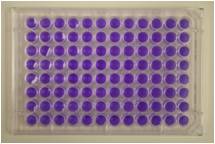
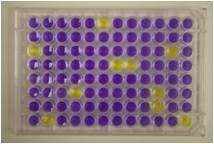
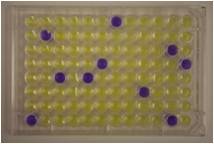
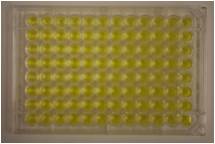
The Muta-ChromoPlate provides a clear colour endpoint. Reagents, cultures and other consumable components are supplied ready-to-use in a non-specialized laboratory. The Muta-ChromoPlate kit is based on the most generally used and bacterial reverse mutation test, known as the Ames Test (Ames et al., 1975 Mutation Research 31:347) The test employs a mutant strain, or several strains, of Salmonella typhimurium, carrying mutation(s) in the operon coding for histidine biosynthesis. When these bacteria are exposed to mutagenic agents, under certain conditions, reverse mutation from amino acid (histidine) auxotrophy to prototrophy occurs. Traditionally, reverse-mutation assays have been performed using agar plates. An alternate assay performed entirely in liquid culture is the 'Fluctuation Test' based on multiple yes/no colour endpoints (Hubbard, S.A et al., 1994, pp. 141-160, in Kilbey et al. (Eds.), Handbook of Mutagenicity Testing (2nd Ed,.) Elsevier Sciences, NY. This test principle is being applied in the Muta-ChromoPlate test kit. The Muta-ChromoPlate Kit is generally more sensitive (up to 10 times) than the pour-plate assay, because it allows testing of higher concentrations of sample (up to 75% v/v). The assay procedure is simple and requires minimal training. Consumable components are provided with ready-to-use and step-by-step instructions. "Instructions for Use" are provided with the basic kit. The only equipment required are a 37 degree Celsius incubator and a single and a multi-channel micropipettor. What New with EBPI's Ames Strains? EBPI has developed a new line of Ames Express bacteiral strains that include an internal bio-activation based on human recombinante liver enzymes. EBPI visit www.Biotoxicity.com to learn more about this new exciting product launch. S9 Activation Enzymes S9 is a crude liver enzyme extract that can, under certain conditions, convert materials without any genotoxic activity to active genotoxic entities. The chemical process involved is probably different for different materials. In addition, the lifetime of the activated moieties is extremely variable: some may be extremely short-lived. This is the reason for incubating the S-9 with the bacteria and the tested material at the same time. |
||||||
Applications: Testing of pharmaceuticals for mutagenic activity. Testing of industrial effluents for presence of possible mutagenic compounds. Screening of municipal discharges for possible routine presence or spills of mutagenic compounds. Screening of surface and ground water for mutagenic residues. Screening of potable water supplies for the presence of chemicals with mutagenic potential. Screening of water soluble air pollutants for mutagenic agents. Evaluation of pure or complexed raw mixtures for potential mutagenicity. A convenient and easy to use teaching look for university and college laboratories. The Muta-ChromoPlate kit (Ames Test Kit) is designed to be user friendly by removing potential contamination concerns. Strains Currently Available to be shipped are: TA97a, TA98, TA100, TA102 and the TA1535. Reverse Mutations in Various Bacterial Strains
Click Here for a visual understanding on how the Muta-ChromoPlate kit is preformed |
||||||
.jpg)